
Mosh Pit in the Kitchen

The Tidal MCP I was using had one job: let Claude see my music library and create playlists. I’d tell Claude what I was about to do and ask for a soundtrack: a long Mythic+ grind in WoW, or the right headspace for a writing session. It did all of that for a little while, and then it needed to be reconnected. Far too often, I’d ask Claude about my playlists and get a polite digital shrug. Reconnect, re-authorize, carry on. Repeat until the shrug starts feeling personal.
At some point you have to ask yourself the obvious question: why am I putting up with this? I can code, and I have a Claude Code subscription. So I decided to build my own Tidal MCP.
The plan
I sat down with Claude Code and planned it before writing anything. What did I want? A private MCP server that lets Claude read my Tidal library and edit playlists, working everywhere I use Claude: web, desktop and phone. That last part meant a remote connector with proper OAuth rather than something running on my laptop.
We settled on TypeScript on Cloudflare Workers, which is free, fast and needs no server for me to babysit. For data, Claude Code went with the official Tidal API rather than the unofficial private one a lot of other Tidal MCPs lean on. I didn’t even know that was a fork in the road until afterwards, so that’s a quiet win for the planning step. Then I handed over what it needed: access to Cloudflare and the API keys from a Tidal developer app I’d set up.
The part I’m quietly proud of is the login. There are two OAuth layers, with the Worker in the middle. Claude connects to the Worker, and the Worker handles Tidal. My Tidal tokens are stored encrypted and refreshed automatically, which is exactly what the old connector kept fumbling. Claude itself never sees my Tidal token, and only my own Tidal account is allowed to sign in.
25 minutes later
Everything from planning to deploy took about 25 minutes. Then Claude made its first playlist.
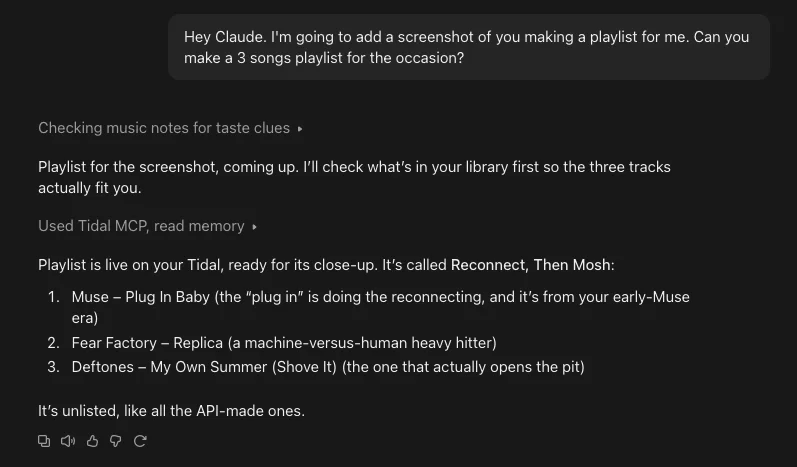
Claude looked at my library, thought about my taste, and built a 12-track playlist called Mosh Pit in the Kitchen. It’s a banger. I will not be taking questions.
Most of it was songs I already love today, sitting squarely in my alt rock and metal wheelhouse, which was reassuring on its own. But a few tracks were ones I’d never heard before, and they were great. They didn’t just survive the first listen. They earned a permanent spot on the playlist.
That’s the moment that got me: it hadn’t just read my library, it had understood it well enough to find things I didn’t know I was missing.
Since then it has added 12 songs to my Hip Hop playlist, and I’ve had Claude read a playlist out loud to me on my phone. The Tidal MCP has 11 tools in total: search, reading my library (tracks, albums, artists) and playlists, and creating, editing and trimming playlists.
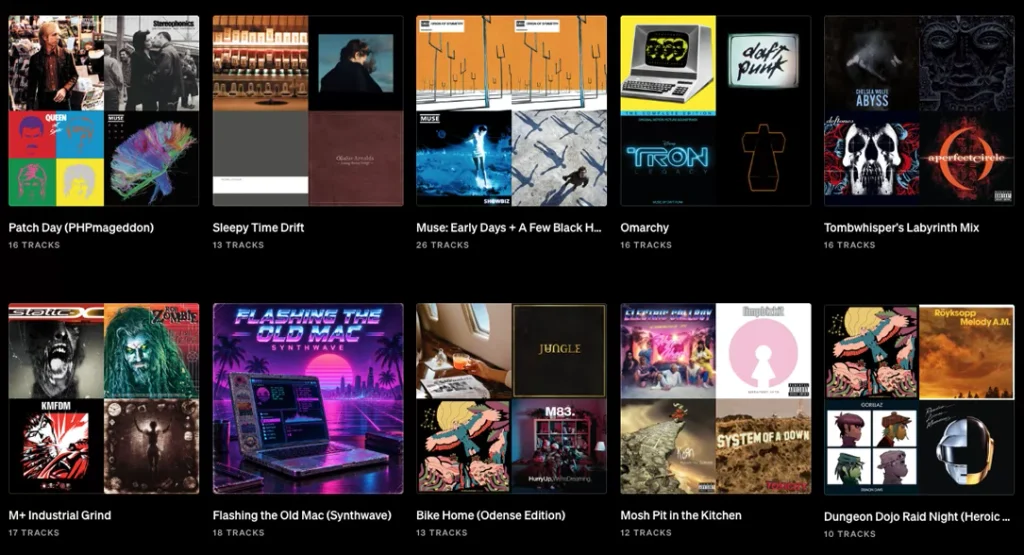
It has also created plenty of playlists since, like these delights:
- Flashing the Old Mac (Synthwave)
- M+ Industrial Grind
- Tombwhisper’s Labyrinth Mix
- Muse: Early Days + A Few Black Holes
- Patch Day (PHPmageddon)
- And more…
The things we learned and adjusted for
Even with a turnaround this quick, we still ran into a hiccup and picked up a few learnings along the way.
- Rate limits. Tidal gets grumpy if you fire off too many searches at once, so the server batches them and retries.
- Playlists come out unlisted. That’s how the API creates them.
- No delete-playlist tool. Deleting playlists was an option, but we decided to leave it out, just to be safe. It can remove tracks from a playlist, but it can’t nuke one.
So how’s it going?
It’s been running for over a week now without a single reconnect. For a tool I was previously re-authorizing all the time, that feels like witchcraft.
I think this is the bigger thing. We live in a world where, if the tool you’re using doesn’t do what you want, you can just make your own. It took less time than curating a playlist by hand. A few years ago this would have been a weekend project, or one I’d never have started. Now it’s a quick lunch-break project, and the result does exactly what I want and nothing I didn’t.
Now if you’ll excuse me, there’s a mosh pit in my kitchen.